Oil Hits New Highs as Iran Threatens US Ships in Gulf
Rising energy costs and heightened military tensions are reshaping the landscape for regional stability and global markets.
By Juan Gonzalez ·
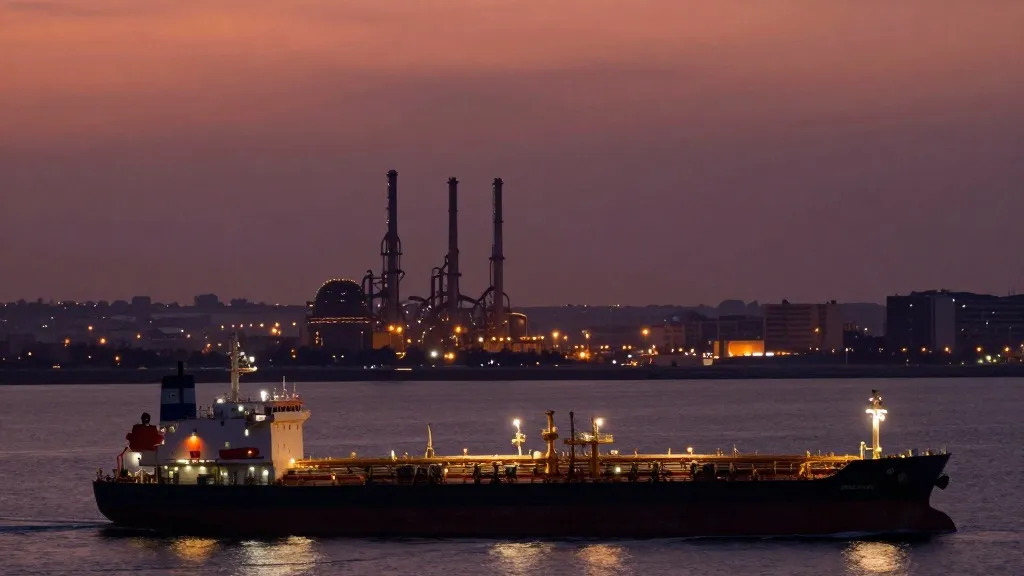
For millions of commuters and families relying on stable fuel prices, the cost of living just took another sharp turn. Brent crude oil prices have climbed to approximately $117 per barrel, marking the highest level since April. This surge is a direct consequence of renewed hostilities in the Persian Gulf, where shipping lanes are under constant threat and the prospect of a wider war looms over global supply chains. The immediate impact is felt in the price of gas, heating, and transportation, adding financial pressure to households already navigating a complex economic landscape.
The escalation is driven by a mix of military posturing and diplomatic deadlock. Iran’s armed forces have declared readiness to fire on United States warships, signaling a significant shift in their defensive strategy. President Donald Trump indicated that Washington has not yet decided on its next move in the conflict. Speaking at a rally in Florida on Friday, he suggested the US military "may do another Epic Fury," a nod to the massive bombing campaign that launched the war. This uncertainty keeps markets on edge, as traders weigh the risks of a prolonged naval standoff against the possibility of another large-scale aerial assault.
Military leaders in Tehran are sending clear messages to their counterparts in Washington. Ali Abdollahi, the chief of general staff for Iran’s armed forces, stated on Saturday that the US Navy cannot re-enter Iranian territorial waters or its immediate surroundings. He argued that Iran can target any vessel in the region, telling the American president that he can only "dream" of his soldiers entering the Persian Gulf again. Abdollahi also criticized American rhetoric as contradictory, noting that while the US claims Iranian military capabilities are largely destroyed, its aircraft carriers remain at a distance. He framed the current situation as a response to a surprise attack on February 28, which began an eight-month conflict that unsettled the entire region.
The Strait of Hormuz, a critical chokepoint for global energy supplies, remains a focal point of the conflict. The Islamic Revolutionary Guard Corps reported that seven tankers were attacked or hit mines in the hours leading into Thursday. By Friday, the group claimed that two additional supertankers had struck mines. The IRGC has stated that its doctrine has become more offensive, aiming to "drown" the US and Israel in a quagmire. These attacks on commercial shipping directly influence the oil market, as insurers and shipping companies adjust their rates and routes to account for the increased risk of damage or delay.
Beyond the Gulf, other fronts in the region are seeing increased activity. The Iran-allied Houthis in Yemen struck Riyadh on Saturday, following recent attacks on Dammam’s international airport and the Shaybah oilfield. In response, Saudi forces have bombed areas held by the Houthis, including Marib and Taiz. In southern Lebanon, reported Israeli air strikes hit areas near Nabatieh, with artillery falling near Zawtar ash-Sharqiyah. These simultaneous engagements suggest that the conflict is spreading, with multiple actors engaged in coordinated and retaliatory strikes that complicate efforts to de-escalate the situation.
Political developments in Israel are also influencing the timeline for conflict. Prime Minister Benjamin Netanyahu, who faces an election on October 27, ordered a lockdown of the occupied West Bank after a Palestinian attack killed two soldiers in Hebron. This move underscores the tight connection between domestic political pressures and military decision-making in the region. For working families and communities in the area, such lockdowns can mean disrupted commutes, closed businesses, and increased uncertainty about safety and daily routines.
Diplomatic efforts to resolve the crisis have stalled. Senior diplomats from Turkiye, Saudi Arabia, Pakistan, and Egypt met with counterparts from the UK, France, Germany, and Italy in Istanbul on Friday. Neither the US nor Iran was present for the discussions. Turkiye’s Foreign Minister Hakan Fidan warned that a new attack on Iran would widen the war and spread the conflict across the region, adding that "no one is endorsing it at this point." While the European ministers blamed the Houthis and Iran for instability, the regional ministers argued that Israeli occupation was the main source of the problem. The group backed a memorandum of understanding signed in Islamabad in June and demanded unrestricted passage through Hormuz.
Analysts and state-linked media in Iran are interpreting the lack of progress in talks as a sign that a new phase of conflict is approaching. Nour News, affiliated with Iran’s Supreme National Security Council, described the Istanbul meeting as showing a gap between diplomatic claims and field realities. They argued that the US and European powers must concede first. Reformist newspaper Etemad suggested that the "zero hour" for another intense round of fighting was near. Analyst Reza Nasri wrote on social media that Iran will no longer negotiate under bombardment and intends to end the cycle by all necessary means. These statements reflect a growing sense of urgency among those tracking the conflict, who see the current standoff as a prelude to further action.
The stakes for ordinary people continue to rise as the conflict enters its final months. With oil prices at their highest in months and military threats escalating, the economic and social fabric of the region is under strain. For working families, the uncertainty affects everything from budget planning to daily travel. As diplomatic talks yield no results and military rhetoric intensifies, the focus shifts to how these global powers will manage the next phase of a conflict that has already reshaped the region’s political and economic landscape.
Source: Al Jazeera